

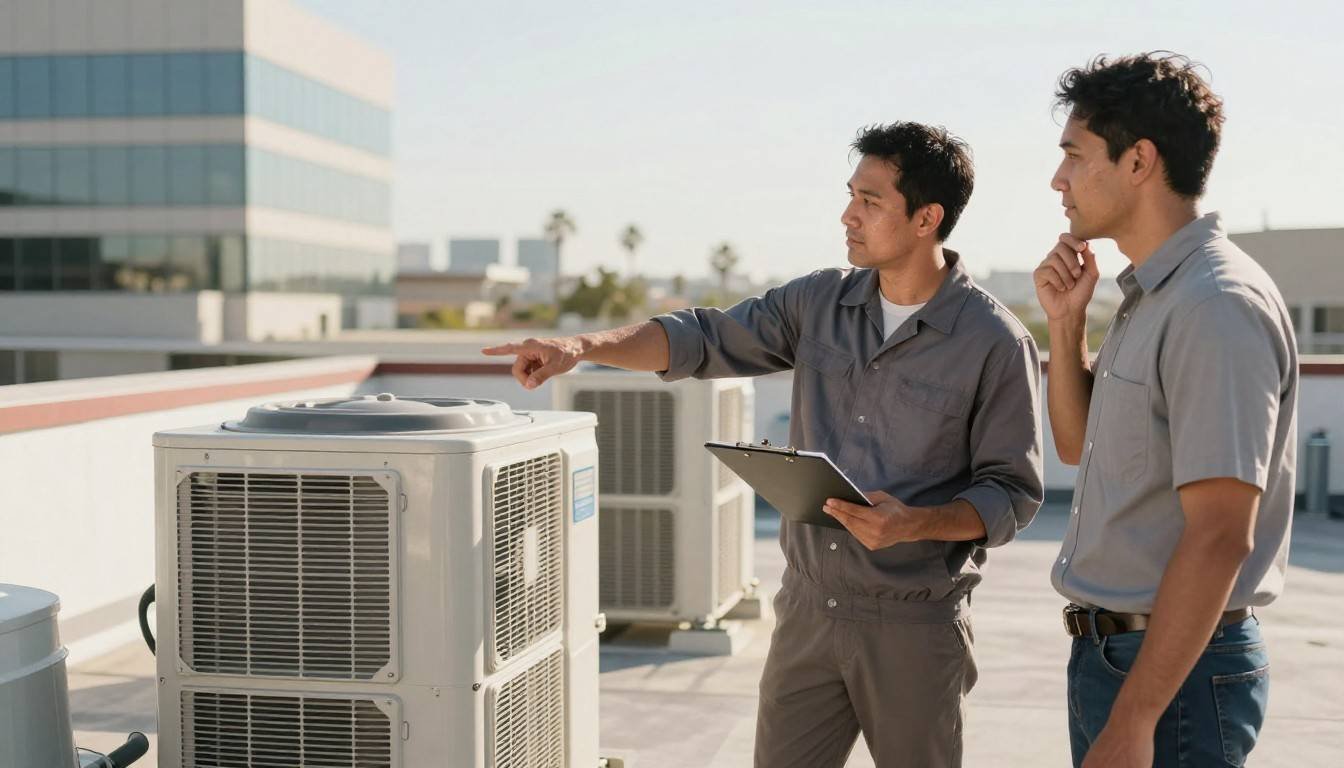
When your AC goes down at home, you call a repair company and wait your turn. When it goes down at your office, your store, or your warehouse, that kind of waiting can cost you real money. That is why commercial HVAC contracts often include a service level agreement, and why the terms of that agreement change depending on what kind of business you run.
Why AC Repair SLAs Are Different for Offices, Retail, and Warehouses
If you run a business in Lake Elsinore, an AC breakdown is not just an inconvenience. It can mean lost sales, unhappy employees, or spoiled inventory within hours. That is why most commercial HVAC contracts include a service level agreement, or SLA, that spells out exactly how fast a repair company must respond.
Not every business needs the same SLA. An office building, a retail store, and a warehouse each face different risks when the AC goes down, so the terms that protect them look different too.
This guide breaks down what an SLA actually promises, how it changes by business type, and what you should look for before you sign one for your property.
What an SLA Actually Guarantees (Response Time, Resolution Time, Uptime)
A commercial AC repair SLA is a written promise, not a general statement of good service. It typically defines a response time, meaning how fast a technician arrives after you call, and a resolution time, meaning how fast the problem actually gets fixed.
Many SLAs also include an uptime guarantee, which sets a target percentage of time your system should stay operational. Some agreements attach financial penalties or service credits if the provider misses these targets.
Why One-Size-Fits-All SLAs Don’t Work Across Business Types
A generic SLA template treats every building the same, but a law office and a cold storage warehouse do not share the same risk profile. One loses productivity during a slow AC failure. The other can lose an entire day’s inventory.
The right SLA reflects what actually happens inside your building when cooling fails, not just a standard response window copied from another contract.
Office AC Repair SLAs: What to Expect and Negotiate
Offices depend on stable indoor temperatures to keep employees comfortable and productive throughout the workday. An SLA for an office building should reflect that steady, predictable need.
Response Time Standards for Office Buildings
Most office SLAs fall in the four to eight hour response window for standard business hours, since the priority is fixing the issue before it disrupts a full workday. Higher-tier agreements offer two to four hour response times for larger buildings with more at stake.
Why Employee Comfort and Productivity Drive Office SLA Terms
A hot office does more than make people uncomfortable. Studies on workplace conditions consistently link overheated environments to slower output and more mistakes, which is exactly why SLA response times matter for office managers watching both comfort and performance.
If you want a real example of how fast a well-structured SLA can turn a bad situation around, this office AC failure case study during a heat wave shows how a building went from a full outage to restored cooling within hours.
Multi-Tenant Buildings and Shared HVAC System Complications
Office buildings with multiple tenants often share a single rooftop unit or a central system, which complicates response time promises. One tenant’s emergency can affect every business in the building, so the SLA needs to clarify who gets priority and how shared costs are handled.
If your building involves a landlord managing HVAC responsibilities across multiple tenants, it helps to understand landlord and tenant AC repair responsibilities before assuming your SLA covers something it does not.
Retail AC Repair SLAs: What to Expect and Negotiate
Retail spaces face a different pressure than offices. Customers do not wait around in an uncomfortable store, and a hot or humid shopping environment affects sales in real time.
Response Time Standards for Retail Spaces
Retail SLAs often set tighter response windows than office agreements, commonly two to four hours during operating hours, since every hour without cooling is a potential hour of lost foot traffic.
Why Customer Comfort Is Tied Directly to Sales
Retail is one of the few business types where AC performance connects directly to revenue. A store that gets too warm sees shoppers leave faster and stay for shorter visits, which is a real cost that a fast SLA response helps prevent.
Peak Season, Weekend, and Holiday Coverage Requirements
Retail traffic spikes on weekends and during peak shopping seasons, which are exactly the times a standard business-hours SLA might leave you uncovered. Look for agreements that extend response guarantees into evenings, weekends, and holidays if your store depends on that traffic.
Warehouse AC Repair SLAs: What to Expect and Negotiate
Warehouses carry a different kind of risk. Instead of comfort, the priority is often protecting inventory, equipment, or temperature-sensitive goods from damage.
Response Time Standards for Warehouses and Distribution Centers
Warehouse SLAs vary more than office or retail agreements because the stakes depend heavily on what is stored inside. A facility holding temperature-sensitive products needs a much faster guaranteed response than one storing non-perishable goods.
Why Inventory and Equipment Protection Change SLA Priorities
A warehouse AC failure is not just about comfort for staff. Rising temperatures can damage electronics, spoil perishable inventory, or push equipment past safe operating limits, so warehouse SLAs often include stricter uptime guarantees tied directly to financial loss prevention.
Ventilation, Loading Dock Areas, and Large-Footprint Cooling Challenges
Warehouses also deal with larger square footage, higher ceilings, and loading dock doors that open and close constantly, all of which create cooling challenges an office building never faces. Poor duct design or airflow gaps can look like an AC problem when the real cause is something else entirely, which is worth ruling out before assuming the system itself has failed.
Key SLA Terms and Coverage Tiers Every Business Owner Should Understand
Before signing any commercial AC repair contract, you need to understand exactly what the SLA promises and where the gaps might be.
Response Time vs. Resolution Time (They’re Not the Same Thing)
Response time is how fast someone shows up. Resolution time is how fast the problem actually gets fixed. A four hour response guarantee means nothing if the resolution time has no cap, so make sure your SLA defines both clearly.
Parts, Labor, and After-Hours Coverage: What’s Included and What’s Not
Read the fine print on what counts as covered work. Some SLAs include standard parts and labor but bill separately for major repairs, refrigerant, or after-hours emergency calls. Knowing this ahead of time helps you avoid a surprise bill during an already stressful breakdown, and understanding how to read an AC repair estimate can help you catch hidden fees before you agree to anything.
Basic, Standard, and Premium Coverage Tiers Compared
Most commercial HVAC providers offer tiered coverage. A basic tier usually includes routine maintenance and a slower emergency response window. A standard tier adds faster response times and more included parts. A premium tier typically includes 24/7 emergency coverage with the fastest guaranteed response and the broadest parts and labor inclusion.
What Happens When an HVAC Provider Misses an SLA
An SLA is only as strong as what happens when it is not met. This section of the contract protects you if the provider fails to deliver on its promises.
Uptime Guarantees, Service Credits, and Penalty Clauses
Many commercial SLAs include service credits or penalty clauses if response or resolution times are missed. This might mean a discount on that month’s service fee or a credit toward future repairs. Ask exactly how these are calculated before you sign.
Escalation Procedures You Should Ask About Before Signing
A good SLA outlines what happens if the first technician cannot resolve the issue or if the response window passes without contact. Ask who you escalate to, how quickly a manager gets involved, and what recourse you have if the pattern repeats.
What AC Repair SLA Coverage Typically Costs Lake Elsinore Businesses
Commercial AC coverage pricing depends heavily on your building size, system complexity, and the coverage tier you choose.
Pricing Factors: Facility Size, System Age, and Coverage Tier
Larger facilities with multiple rooftop units cost more to cover than a small single-unit office. Older systems often carry higher maintenance costs since they need more frequent attention, so ask how your system’s age factors into your quote. If you are weighing whether an aging system still makes sense to maintain under a service contract, comparing repair costs against a system upgrade can clarify the long-term math.
Comparing SLA-Backed Coverage Costs to Pay-As-You-Go Emergency Repairs
Paying for emergency repairs one at a time might look cheaper upfront, but it usually costs more over a full cooling season once you factor in after-hours rates and unpredictable timing. An SLA spreads that cost out and guarantees priority service instead of leaving you competing for a technician during the busiest weeks of summer. If your business qualifies for rebate programs, this HVAC rebate checklist for homeowners and small businesses is worth reviewing before you budget for new coverage.
Why Lake Elsinore’s Summer Heat Puts SLA Response Times to the Test
An SLA that looks solid on paper gets tested the moment every business in town needs a technician at the same time.
Peak-Season Technician Availability When Every Business Is Calling at Once
During extended heat waves, AC systems fail more often across the board, which stretches every HVAC company’s technician availability thin. This pattern is well documented in why AC systems fail more often during late summer heat spikes, and it is exactly why your SLA’s guaranteed response time matters most during the hottest stretches of the year, not the mild months when demand is low.
A good way to understand what your technician’s day actually looks like during these periods is this inside look at a day in the life of an AC technician during peak summer, which shows how quickly schedules fill up once temperatures spike.
Choosing the Right SLA for Your Office, Retail Space, or Warehouse
Once you understand how SLAs differ by business type, the final step is matching the right agreement to your specific property and risk level.
Questions to Ask and a Provider’s Track Record to Verify Before You Sign
Ask how the provider tracks and reports SLA compliance, what percentage of calls they actually meet their stated response time on, and whether they can name reference customers with a similar building type to yours. A provider confident in their numbers should have no problem answering directly.
If you are unsure whether a noise or smell coming from your system counts as the kind of emergency your SLA response time should cover, this guide on true AC emergencies during extreme heat can help you make that call quickly.
Red Flags That Signal a Weak or Unenforceable SLA
Watch for vague language like “prompt service” instead of a specific number of hours, no mention of what happens when a deadline is missed, and unclear definitions of what counts as an emergency versus routine work. These gaps usually favor the provider, not you.
If you are ready to compare coverage options for your office, retail space, or warehouse, the team behind Air Conditioning Repair Lake Elsinore can walk you through what a properly structured SLA should include for your specific property. Reach out through the contact page to start that conversation before your next heat wave puts your current coverage to the test.
FAQs
Q1. What is a typical AC repair SLA response time for a commercial business?
Response times generally range from two to eight hours depending on the business type and coverage tier. Retail and warehouse facilities with higher risk often negotiate faster windows than standard office buildings.
Q2. Do offices and retail stores need different AC repair SLAs?
Yes. Offices prioritize steady comfort during business hours, while retail spaces need faster response times tied to customer traffic and often require weekend and evening coverage that offices may not need.
Q3. How is a warehouse AC SLA different from an office AC SLA?
Warehouse SLAs focus more on protecting inventory and equipment from heat damage, while office SLAs focus on maintaining comfortable, productive working conditions. Warehouse agreements often include stricter uptime guarantees.
Q4. What happens if an HVAC company misses its SLA response time?
Most SLAs include a penalty clause or service credit for missed deadlines, along with an escalation procedure. The specifics vary by contract, so it is worth confirming exact terms before you sign.
Q5. Should a small retail store bother with a formal AC service SLA?
Yes, especially if a single hot day can noticeably affect foot traffic or sales. A formal SLA gives you a guaranteed response window instead of competing with every other business calling during a heat wave.
Q6. How much does commercial AC SLA coverage cost compared to one-off repairs?
SLA coverage typically costs more upfront but often saves money over a full season by avoiding after-hours emergency rates and unpredictable repair timing. Costs vary based on facility size, system age, and coverage tier.
Q7. What's the difference between response time and resolution time in an SLA?
Response time is how quickly a technician arrives after you report an issue. Resolution time is how quickly the actual problem gets fixed. A strong SLA defines both separately.
Q8. Can an SLA guarantee my business never loses AC during a heat wave?
No SLA can guarantee a system never fails, but a strong agreement guarantees a fast, prioritized response so downtime stays as short as possible when a failure does happen.
Q9. What should I look for in an SLA before signing a commercial HVAC contract?
Look for specific response and resolution time numbers, clear penalty or credit terms for missed deadlines, defined coverage for parts and after-hours work, and a documented escalation process.
Q10. Can one HVAC provider manage SLAs for multiple business locations with different needs?
Yes, many commercial HVAC providers structure separate SLA terms for each location based on that property’s building type, system size, and risk level, even under one overall service agreement.